AI operating system: How AI agents are replacing existing hierarchies and processes

According to OpenAI CEO Sam Altman, there are various predictions as to the year in which the first one-person billion-dollar company will emerge. And this is no coincidence: the big trend in Silicon Valley – and elsewhere – is currently to build companies that are as small as possible, yet highly valuable.
This is because companies with a strong focus on AI manage with a quarter fewer staff, have flatter hierarchies and fewer managers than comparable start-ups. Two researchers came to this conclusion this summer, thereby raising a fundamental question for businesses: what work in organisations is truly still dependent on people, when more and more tasks can be taken over by AI agents? And how large and complex should organisations even be in future?
The fact that even larger, long-established companies are now following the trend towards downsizing is currently evident on the labour market: according to a survey, 11 per cent of companies in Switzerland are no longer filling vacancies due to AI, whilst 7 per cent are cutting them altogether. At the same time, 42 per cent of employees are unable to assess the implications for their own jobs.
What an AI operating system for an organisation might look like
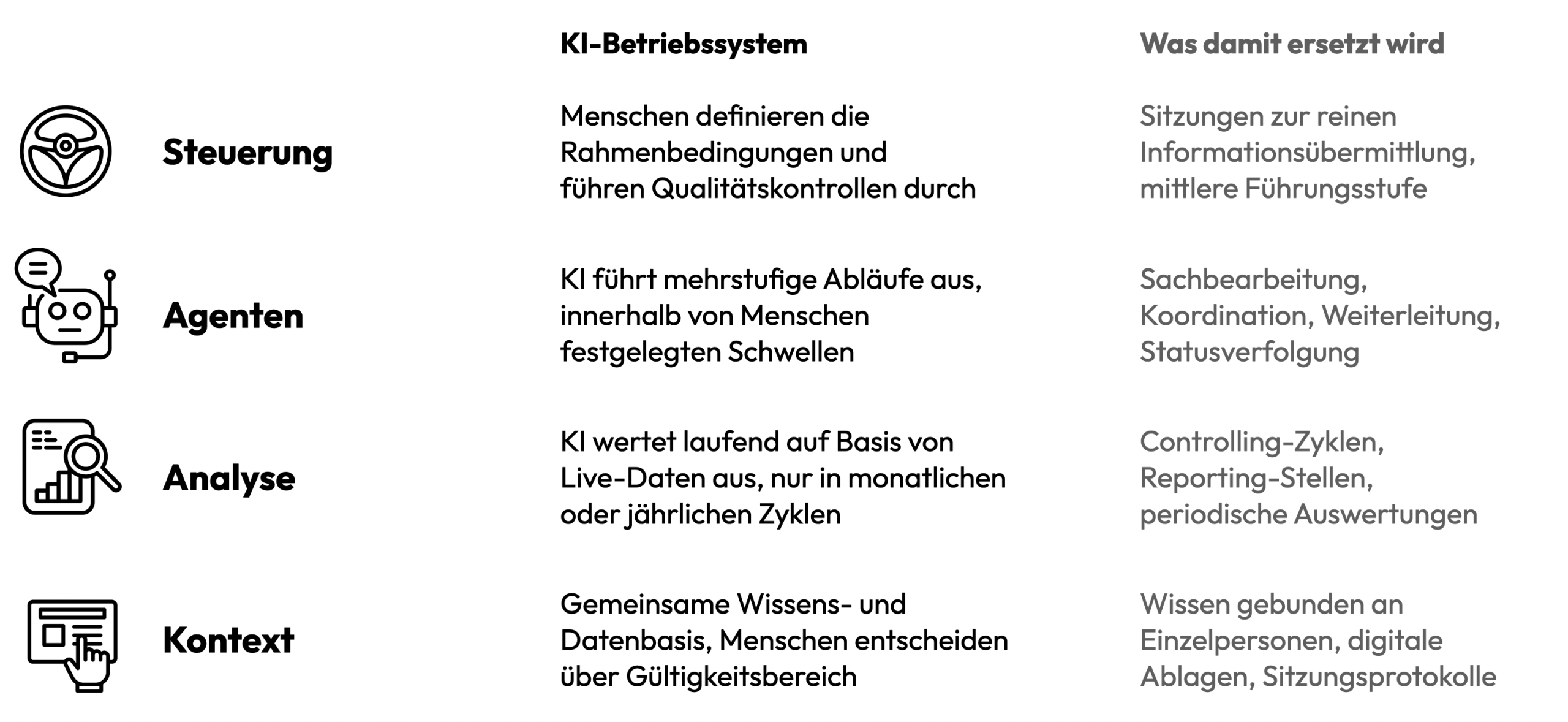
AI has long since ceased to affect merely individual work steps; instead, it is fundamentally transforming the structures and processes of organisations. An AI operating system of this kind is built on a shared knowledge base: it replaces the siloed knowledge previously stored in people’s minds, digital folders and meeting minutes.
This is what agents rely on when carrying out routine procedures, coordination and real-time analysis. The role of the human is shifting as a result: they control the system via clear thresholds and quality controls, thereby rendering meetings and management positions redundant, the sole purpose of which had previously been the mere passing on of information.
Why traditional hierarchies are breaking down in the age of AI
As a result, complexity within organisations is shifting increasingly away from traditional hierarchical levels towards specific processes and rules. Organisational researchers Oliver Baumann and Brian Wu refer to this as the ‘phantom hierarchy’: the hierarchy remains effective, but is no longer visible in the organisational chart. According to the authors, a leadership role will therefore in future be measured by the ‘span of accountability’ rather than the span of control: the ‘span of accountability’ no longer describes how many people someone leads, but how many far-reaching decisions a person is responsible for.
This includes the important distinction between ‘verifying’ and ‘being authorised to’: whilst an AI agent may correctly verify a proposal, it may still not be authorised to carry it out on behalf of the organisation. Christoph Heitz, a professor at ZHAW who founded the Swiss Centre for Responsible AI, summed up what human verification really means in an interview.

‘Someone who clicks “Confirm” at the end is not yet a valid check.’
Prof. Dr Christoph Heitz, founder of the Swiss Centre for Responsible AI
This makes it all the more important to exercise caution here. Research clearly shows that people follow recommendations made by machines, particularly when under time pressure. Even in an AI operating system, legal responsibility still lies with humans – and at the same time, our dependence on AI systems is growing.
McKinsey therefore advises: ‘own the context, rent the tech’. Context is the only thing an organisation can own in the AI era. This raises an important question for every business: Is the shared knowledge and data base within our organisation structured and documented in such a way that AI agents can work with it?
What distinguishes newly established organisations from existing companies
Anyone setting up a new organisation today often approaches processes from the perspective of the end result and incorporates AI agents right from the start. This means there is no need for time-consuming coordination meetings in the first place. The team can therefore start out smaller and build up the company’s knowledge base from day one in such a way that machines can read and process it.
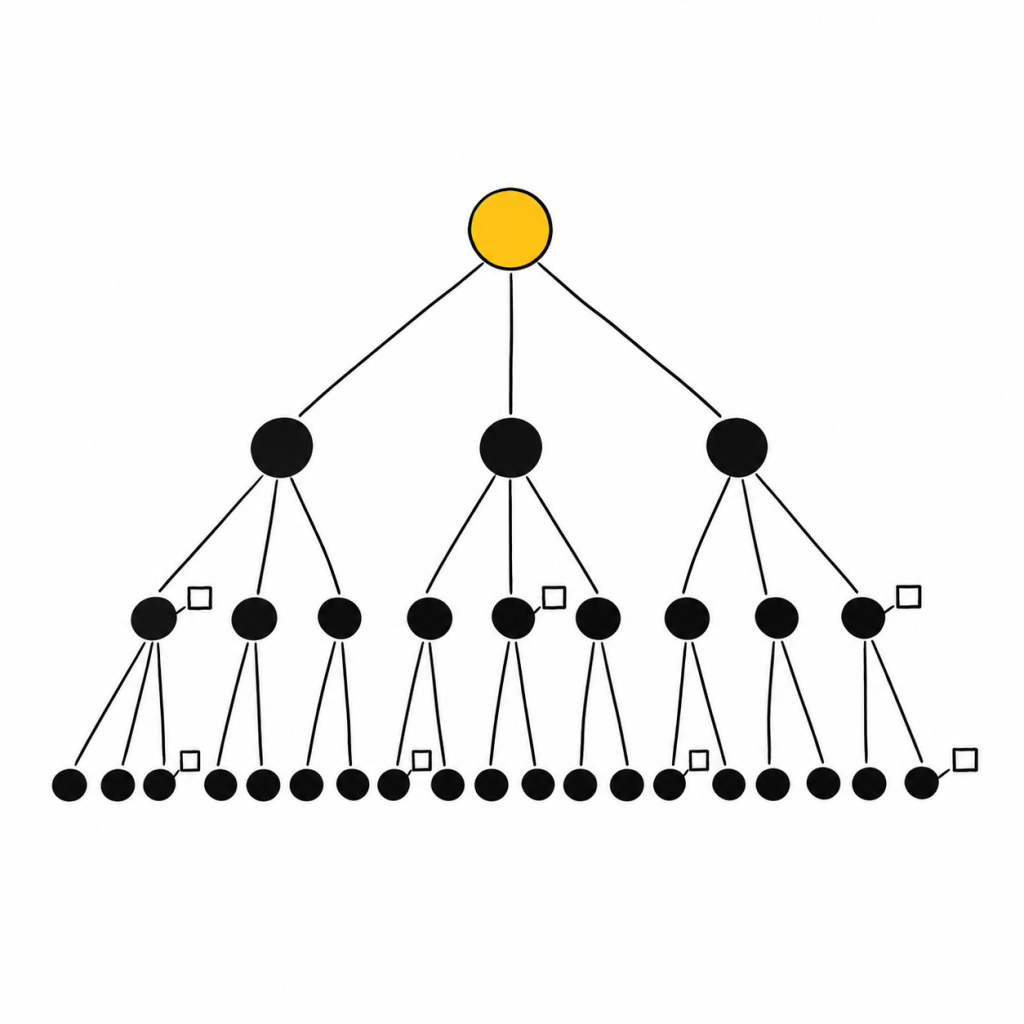
In established companies, the situation is quite different: processes have evolved over time and exist primarily in the minds of the staff concerned. Middle managers hold the organisation together, which also serves as the basis for their legitimacy. As a result, the knowledge context must first be painstakingly reconstructed when AI agents are introduced.
That is why, for existing organisations, the AI transformation means one thing above all else: making the knowledge base accessible, then clarifying decision-making processes, only then deploying AI agents, and finally adapting the structures. However, most organisations take exactly the opposite approach: they first acquire expensive AI tools, then cut jobs, and only realise afterwards that nobody knows how the processes actually used to work.
5 concrete steps for AI transformation
The introduction of AI agents is therefore a management task, and it involves far more than simply deciding on the next AI tool and organising the relevant training. Management teams wishing to actively steer the AI transformation should follow these five steps:
Step 1: Appoint a person responsible for each core process
For each process that is to be taken over by an AI agent in future, appoint a person to be responsible for it. BCG refers to this role as the ‘Agentic Process Owner’; at Salesforce, it is known as the ‘Agent Manager’. In an organisation with 150 staff members, this rarely amounts to more than eight to twelve processes. If one of these processes is handed over to an AI in an incorrect manner, the AI will only amplify this error.
Step 2: Invest in the knowledge base first, then in AI licences
Document your processes, clarify terminology and clean up internal data before spending money on expensive software licences. In practice, AI agents almost always fail due to an incomplete knowledge base. You should also ensure, through a contract, that you have the right to stop, override or reverse the AI’s decisions at any time. After all, the responsibility remains with you: in a 2024 court ruling, Air Canada was held liable because its chatbot had invented incorrect fares for a customer.
Step 3: Decide early on where the time saved should be channelled
Job cuts, improved quality or new tasks: set out clearly how you intend to utilise the working time freed up by AI agents. However, be wary of making hasty redundancies. Initial surveys show that roles cut too hastily often have to be filled again soon afterwards – usually because valuable practical knowledge has been lost within organisations and the effort required to monitor the AI was underestimated. A reduction in staff numbers should be the result of a proven, long-term reduction in workload, and never a prerequisite for it.
Step 4: Protect moments of learning in order to maintain your own judgement
If you hand over routine tasks entirely to AI, you are depriving staff of the opportunity to practise their own decision-making. You should therefore make a conscious effort to ensure that manual tasks are carried out on a regular basis. However, ensure that human oversight does not degenerate into a mere rubber-stamping exercise: those carrying out checks need time, full access to the source data and unrestricted authority to override the AI without feeling pressured to justify their decisions.
Step 5: Treat AI agents as tools rather than staff members
Do not give agents first names or job descriptions, and under no circumstances include them in the organisation chart. Research shows that as soon as software is humanised, the necessary scepticism wanes and errors are rubber-stamped without scrutiny. Instead, establish pragmatic verification and escalation rules with clear boundaries: for example, a human should only specifically check invoices above a certain amount, rather than holding up the entire process. And always bear in mind: an agent is not liable for anything. The responsibility remains with you.
None of these five steps costs a job, but all five require time from senior management. And it is precisely this time that is usually the first to be cut during cost-cutting measures: improving efficiency is currently right at the top of senior management’s list of priorities, whilst strategic groundwork has slipped far down the list.
However, if saving becomes a habitual reflex, there is simply not enough time to actively set the course for one’s own organisation. After all, it is precisely these fundamental questions that determine how companies will operate in a few years’ time.
3 scenarios for how organisations might be structured in 2030
Research suggests three possible scenarios for organisational structure in 2030:
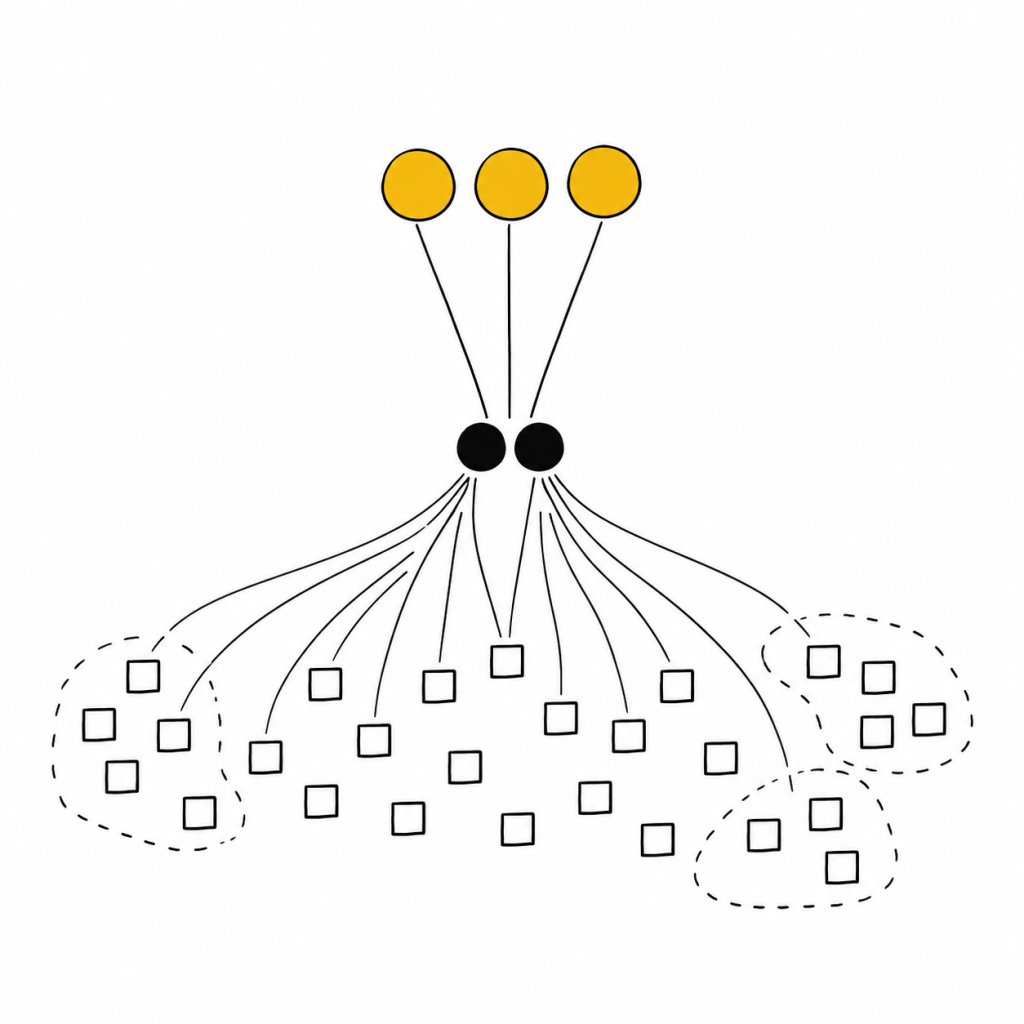
Scenario 1: The Hourglass Organisation
A small core group of leaders makes the decisions, the middle management layer disappears almost entirely, and the actual work is flexibly outsourced to partner organisations and AI agents. Decisions are made at the top; execution takes place at the bottom. This model is particularly effective where services can be standardised and are subject to little regulation – for example, in agencies, associations or media organisations.

Scenario 2: The radically flat large organisation
The workforce remains large, but hierarchical levels and management positions are being drastically reduced. Coordination between teams is no longer handled by the head of department, but by software running in the background. Organisations whose core services must remain on-site, either in person or physically, such as hospitals, government departments or educational institutions, are tending towards this model.
Scenario 3: The modernised status quo
The organisational chart will remain exactly as it is today. AI agents will simply be used as improved tools to speed up individual tasks in the workplace. This is the path of least resistance and the typical scenario for anyone who invests neither time in building up their knowledge base nor in taking on binding responsibility for processes.
Accordingly, it is not technology that will determine how well-positioned companies are in 2030, but rather the conscious use of the time saved. Those who rush into cutting jobs risk a dangerous loss of control and prevent staff from developing their own learning opportunities. In the long term, this in turn leads to even higher costs rather than efficiency gains.
Any questions? Any other examples?
Does your organisation already use AI agents? And have you already had an open discussion about any of the steps mentioned above within your organisation? Please do let me know by sending me a message via your preferred channel. I look forward to hearing from you!
Once a month, I put together a free newsletter featuring tips and recommended reading on strategy development, change management and transformation.
Around 2,500 regular subscribers already rely on this update for the mind and heart. I would be delighted to count you amongst my loyal readership in future.
Sign up now
Table of Contents